
· 2 November 2026 · 6 min read
Water features that work in Karachi's climate: waterfalls, ponds and water walls
Choose a water feature by its water balance, service access and maintenance needs, not only its appearance or sound.
Updated
By VistaGardens Landscape Team
Choose the experience before choosing the mechanism
A water feature can provide a focal point, a reflective surface or sound beside a sitting area. These are different design objectives. A broad waterfall may create an energetic atmosphere but overwhelm conversation in a confined courtyard. A narrow channel may suit a formal composition yet require careful detailing to keep its edges clean. A water wall can fit against a boundary, but its compact appearance says little about the space needed for its reservoir, pump, plumbing and access. Start with the intended experience and the available maintenance, then choose the type.
Karachi's warm conditions and coastal exposure make water quality, evaporation, wind and equipment durability important considerations. They do not mean that one feature type will always perform best. Shade, orientation and shelter can change operating conditions substantially. Establish whether the feature will run continuously, on a timer or only during use, and decide how it will be managed during an absence or power interruption. A design that remains safe and serviceable when switched off is more practical than one dependent on uninterrupted operation.
Plan for evaporation, splash and dissolved salts
Recirculation reduces the need to replace the entire water volume during normal operation, but it does not make a feature water-free. Water leaves through evaporation, splash, maintenance and leaks. Wide exposure, wind and vigorous splashing can increase losses, so the relationship between falling water and its catchment deserves careful design. A sheltered, controlled sheet of water may suit one site better than a high cascade. Automatic top-up can be useful, but it must not conceal an unresolved leak or operate without appropriate controls.
As water evaporates, dissolved minerals remain and may become more concentrated. Depending on the supply and materials, this can contribute to deposits, staining or equipment problems. Test the intended supply where quality is uncertain and obtain a maintenance approach suitable for the particular installation. FAO's saline-water guidance explains the broader importance of managing dissolved salts and considering the consequences of water disposal; it is not a substitute for a feature-specific water-treatment specification. 1
Understand what waterfalls, ponds and water walls demand
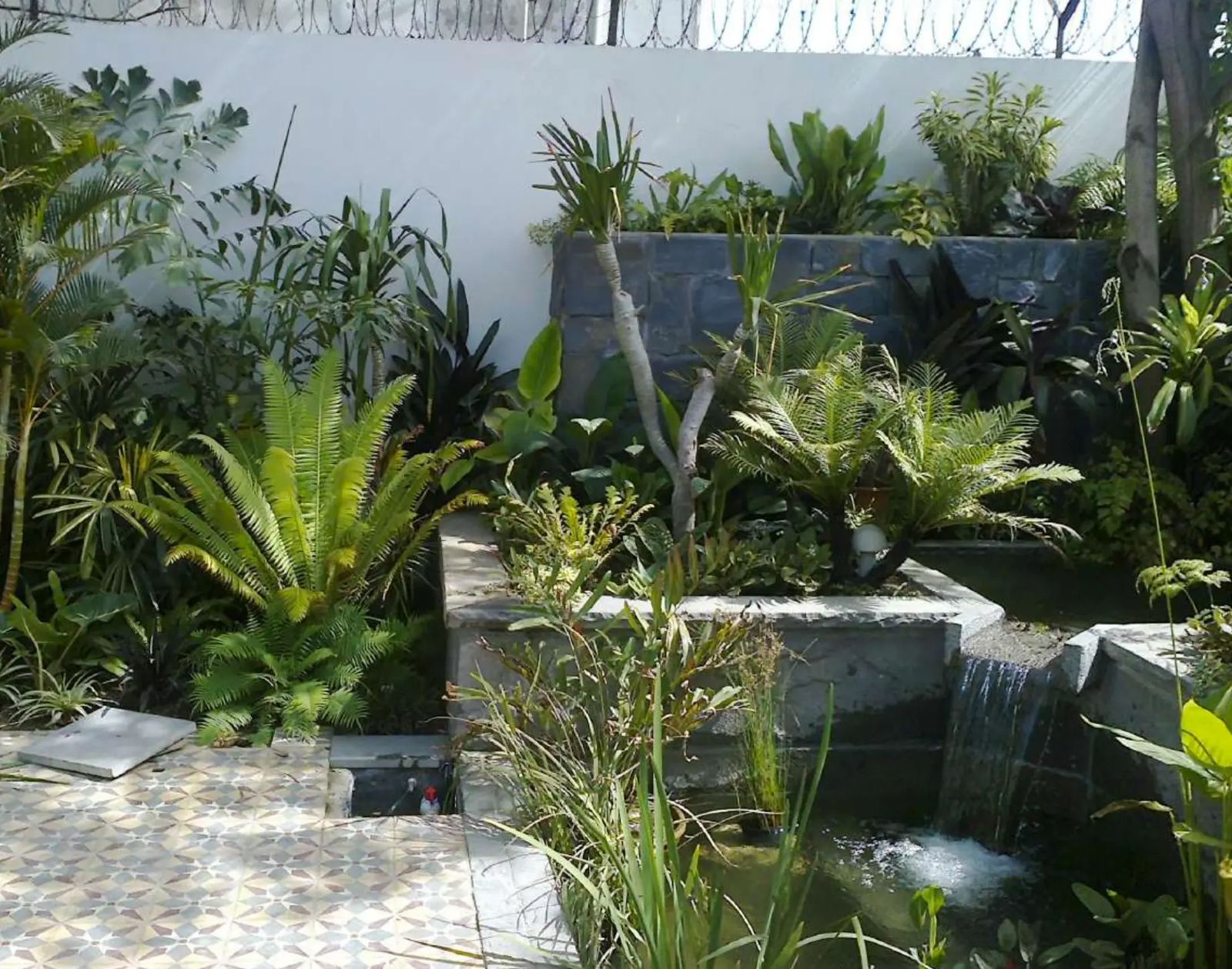
A rock waterfall needs a stable supporting construction, a properly detailed water-retaining system and a catchment that captures the actual flow. Decorative stone should not be expected to provide waterproofing by itself. The pump must be selected for the required flow at the total operating head, accounting for height and pipe losses. An oversized pump can cause splash and excessive noise; an undersized one may fail to create the intended effect. Provide access to connections and a way to remove equipment without dismantling the landscape.
A pond introduces a different set of decisions: intended ecology, sunlight, debris loading, filtration, water depth and edge safety. A fish pond should be designed around animal welfare rather than treating fish as an accessory to a fountain. A water wall requires level distribution, suitable finishes and collection details that contain splash. Each option needs a practical cleaning method. Before approving a design, ask someone to explain how its lowest point, pipework and pump chamber will be reached, drained and serviced.
Design out stagnant pockets and everyday hazards
Moving water should not be treated as a blanket guarantee against mosquitoes. A feature can contain still corners, blocked channels or an uncovered reservoir even when its main cascade is operating. The CDC recommends weekly attention to water-holding containers, including emptying and scrubbing those that can be emptied, and covering stored water appropriately. Permanent ornamental systems need a suitable management plan rather than the assumption that the sound of running water proves every part is protected. 1
Inspect the entire installation, including overflow points, nearby saucers, drain sumps and water retained among decorative elements. Any larval treatment must be locally appropriate, label-compliant and compatible with the feature's intended use and aquatic life. Separately, assess child access, slipping risks, sharp edges and safe maintenance access. Electrical equipment should be installed by a qualified professional using suitable protection for the location. A shallow ornamental basin can still present a hazard, and decorative planting should not conceal unsafe edges or obstruct supervision.
Specify materials and maintenance as one package
The appearance of stone, render, metal or tile changes when it remains wet or receives mineral deposits. Select finishes for the actual exposure and the cleaning methods they can tolerate. Avoid assuming that an aggressive cleaner is safe for every surface, seal, plant or pond inhabitant. Coastal sites also require considered selection of exposed fittings and electrical enclosures. Access panels should be durable, secure and easy to operate; disguising equipment so completely that it becomes inaccessible usually creates a future maintenance problem.
A handover plan should identify normal operating water levels, cleaning tasks, pump isolation, filter access and signs that need investigation. Keep a record of equipment models and the installed arrangement. Watch for changing flow, unusual sound, persistent water loss and repeated staining rather than simply topping up and continuing. Establish responsibility for routine checks and specialist servicing before installation. If that commitment is unavailable, a simpler feature or even a dry sculptural element may provide a more satisfactory focal point than a complex water system.
Use the portfolio to compare design families, not assumed performance
The Tropical Rock & Water Garden documents tropical rockery planting, stone water features, a waterfall, pond fountain and stream. The Pool & Water Channel Residence documents poolside landscaping and a reflecting water channel alongside other residential elements. Both are recorded as Karachi projects; their addresses are not established as DHA. The Private Farmhouse in Sakro documents a lake, rock waterfall and waterfall wall. These records support discussion of feature types, but do not provide published water-use figures, equipment specifications or maintenance outcomes.
When adapting any of these ideas, commission a proposal that explains the feature's footprint, water source, catchment, waterproofing, overflow and equipment access. Ask how wind, power interruption and periods of non-use will be handled. Compare the expected servicing burden as carefully as the visual effect. A water feature works in Karachi's climate when its construction, water management and upkeep suit its exact setting—not simply because a similar-looking feature appears in another garden.
Explore related work
View project: tropical rock water garden · View project: pool water channel residence · View project: private farmhouse sakro
Explore waterfalls water features · Explore water feature servicing · Explore rock gardens rockeries · Explore garden design
Garden services in dha karachi · Garden services in bahria town karachi
Sources and further reading
FAO: Management principles and practices for safe use of saline water
Related from VistaGardens
Want help with your garden?
Book a consultation and we'll visit your space anywhere in Karachi.
Get a free site visit & quote